‘All my friends hate Brian Addison’: The most influential man in Long Beach food is not without his critics
For nearly two decades, Brian Addison has been the dominant voice in the city's culinary ecosystem. A public row with one business owner reopened questions about his ethics and the responsibility that comes with influence.

Editor’s note: Brian Addison is a former co-worker of Watchdog reporter Brandon Richardson, the author of this piece. Their time at the Long Beach Post overlapped by about 10 months.
The culinary landscape in Long Beach is constantly shifting — an endless cycle of hype and heartbreak, the fervor of a buzzworthy opening night followed by the eulogy for a longtime community fixture that’s closed its doors for the last time.
For nearly two decades, the one constant in the flux has been the writer chronicling it.
If there is news related to restaurants and bars in Long Beach, Brian Addison will more often than not be the first to write about it in any notable capacity. Addison has positioned himself as the arbiter of taste in Long Beach and, when it comes to his most avid followers, his word is gospel.
A confrontation with a local restaurateur earlier this year showed some uncharacteristic cracks in Addison’s base of support. For many readers and business owners, the incident brought up questions about the writer’s ethics, hypocrisy and the power structure of the local food and drink industry.
Still, Addison has many defenders.
“As a small business owner, I just want to share my experience - Brian has consistently shown up for businesses like ours in a genuine and meaningful way,” a representative of Lucky Chopsticks said in defense of Addison. “Through the … community he built, we've seen firsthand how much he values supporting local businesses, encouraging thoughtful discussion, and creating a space centered around ‘eat well, be kind.’”
In fact, every person interviewed for this story agreed that Addison has had a positive impact on many local businesses. His critics argued, however, that some of his practices are questionable at best and that he simply has too much power for a healthy, thriving local ecosystem. He has become such a force that many feel obligated to work with him — and scared to call him out.
Addison did not respond to numerous phone calls, texts and emails requesting an interview for this story.
‘Audacious’
The most recent fracas, reported previously by Random Length News, began when Addison published a story on Monday, March 16 about Gusto Bread, a popular panadería in Bluff Heights, expanding into a new Downtown Long Beach location.
According to screenshots posted on social media by both Addison and Gusto co-owner Arturo Enciso, at 2:55 p.m. the same day the article published, Addison had texted a number associated with the business — not either owners’ personal cell, but rather a business line Enciso said is not used frequently.
“Any further info on the Cafe Cuate project in DTLB?” the text read.
Addison did not indicate he was planning to publish an article, nor did he provide a deadline, both of which are common practice when requesting information or a statement from a source.
Busy running his business, Enciso replied about four and a half hours later, saying the company had not announced anything publicly and that negotiations were still underway regarding the space. The story had already been published.
The following day, Enciso texted Addison again, this time to express his disappointment that the article ran without the knowledge of or input from the business owners.
“We would appreciate it if you’d be considerate of our privacy and remove this article … out of common courtesy,” he wrote. “We will gladly share details when we finalize them for your coverage.”
Addison refused, calling Enciso’s text “audacious” and saying removing the story would “violate journalistic ethics.” He went on to say — correctly — that permits for the project are public record and fair game to be reported on regardless of input from the business.
“He’s never accountable for any of it. Now he’s not a writer, he’s a reporter, then maybe he’s not a reporter, he’s a photographer, and then maybe he’s not a photographer, he’s a foodie. Or he’s a blogger. It’s always different titles that he can just keep changing and editing his way out of it.”
— Arturo Enciso, co-owner Gusto Bread
Enciso took to social media on March 18, posting screenshots of the conversation and expressing his frustration with having the announcement publicized prematurely. Addison responded with a post in his Facebook group, Long Beach Food Scene, defending his story.
More than a few commenters agreed with Addison.
“I respect that situations like this can be sensitive, but I hope that his long-standing contributions, intentions, and the positive impact he's had on so many local businesses continue to be recognized,” the Lucky Chopsticks representative said in a comment on that post.
“It was a great article for the business so it is odd that there is so much drama. You are a food news writer, that writes about interesting new food stories in Long Beach,” another commenter wrote. “You aren't writing commercials or ad campaigns or marketing pieces that need to be presented and approved by the business owner. You are a journalist and this is news.”
But many commenters were less understanding. The food group is typically awash in praise for the food writer, but the comment section quickly turned on him. Addison turned off commenting on the post.
That night, Addison sent a string of texts to Enciso: “Dude, what are you doing? You blocked me from your shitty post on IG and now you’re saying I received messages I didn’t in my own group? I’m not copping to something I didn’t fucking do wrong.”
The next day, however, the story was deleted, along with Addison’s Facebook post. He later posted an acknowledgement, which was subsequently edited twice after dozens of commenters called out the fact that no variation of the words “sorry” or “apology” was included in the post.
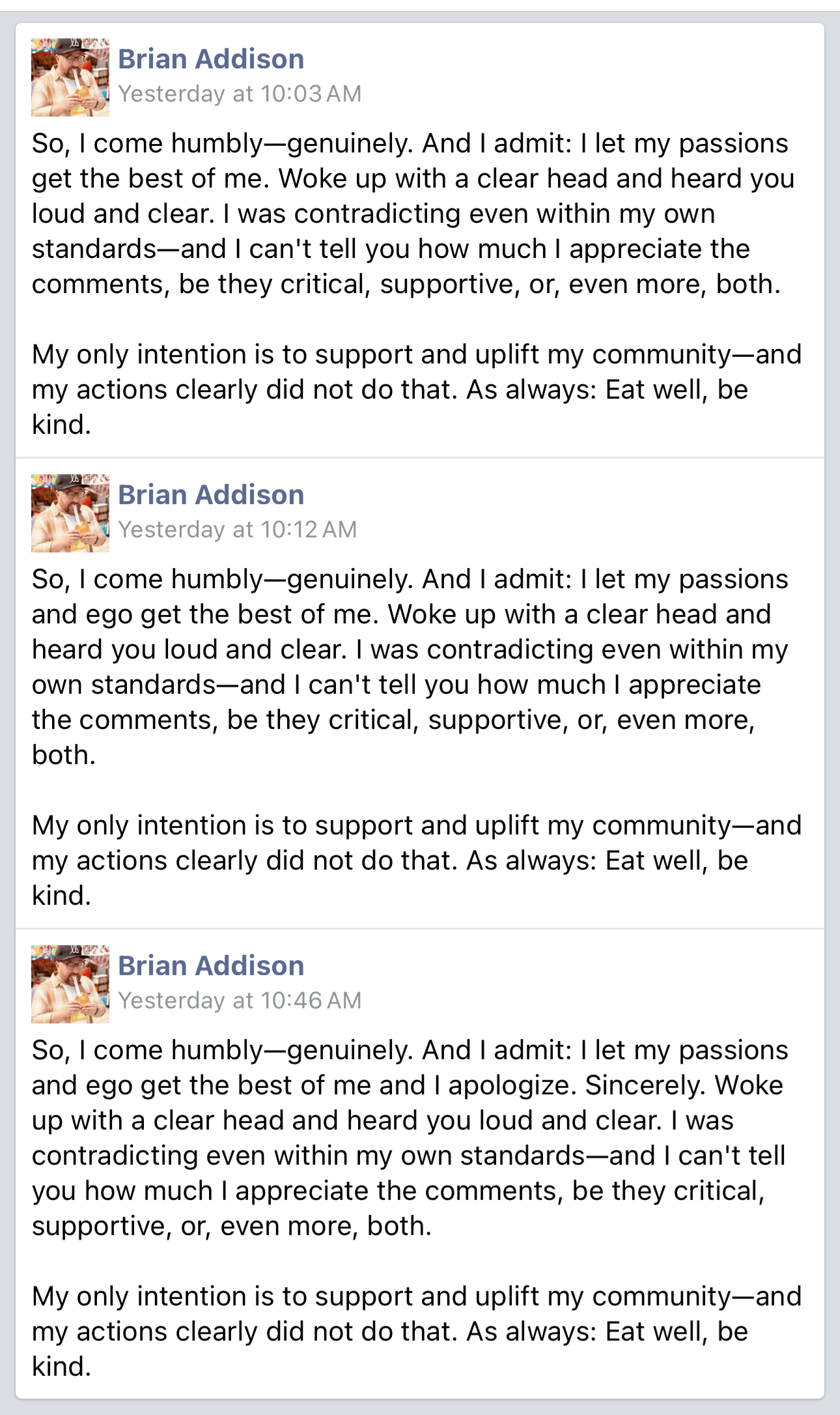
The comments on that post were turned off shortly thereafter.
“I didn’t take [the post] as an apology to me or the business, I saw it as an apology to his Facebook group,” Enciso told the Watchdog, noting that the post did not indicate to whom or for what Addison was apologizing.
Carl Dene, who co-owned Michael’s on Naples and Michael’s Downtown for 18 years, recalled a time when Addison posted a story about his restaurant being sold. When the story was published, the deal had not been finalized, so Dene asked Addison to remove the story. Addison removed it without question, Dene said.
“It was kinda weird that he wouldn’t take it down, I’ll be honest with you,” Dene said of Addison’s initial refusal to remove the Gusto story.
‘I am not a journalist’
A perplexing aspect of Addison’s operation is the inconsistent manner in which he describes himself. He is on record numerous times over the years, including as recently as February, saying, “... I am not a journalist; I am a writer.” Yet, when challenged, he falls back on “journalistic ethics” as a defense.
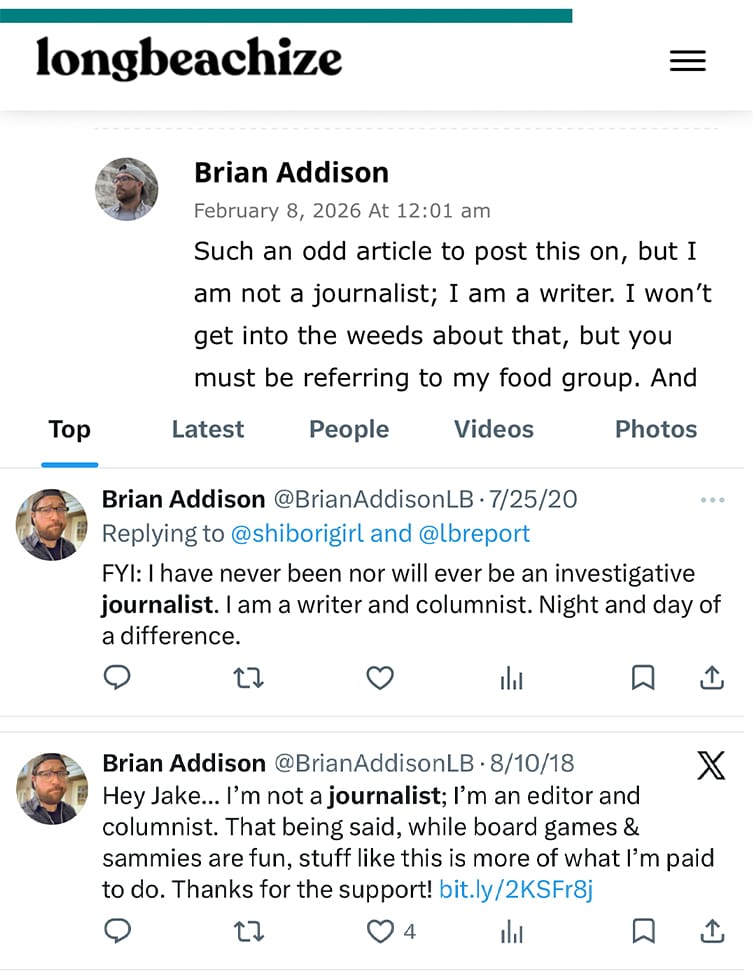
“He’s never accountable for any of it,” Enciso said. “Now he’s not a writer, he’s a reporter, then maybe he’s not a reporter, he’s a photographer, and then maybe he’s not a photographer, he’s a foodie. Or he’s a blogger. It’s always different titles that he can just keep changing and editing his way out of it.”
Addison has no formal journalism training. Originally from Big Bear, he moved to Orange County for college. He attended Cal State Fullerton from 2001 to 2006 where he received a bachelor’s in psychology, according to his LinkedIn profile. He then attended Cal State Long Beach and graduated in 2010 with a Master of Fine Arts in creative writing.
Addison, now 42, has worked for and contributed to numerous publications. His first journalism role was with the Long Beach Post, a news organization he has worked for — and been terminated from — on three separate occasions under three different owners.
Addison’s LinkedIn shows he is still active with LA Streetsblog, though he has not had a byline on the organization’s site since March 2024. His LongBeachize blog, originally founded by Long Beach graphic designer and communications professional Baktaash Sorkhabi as a “community organization and news website” covering “transportation, land-use governance, planning, open space, sustainability and well-being,” used to be a sister site with Streetsblog. It’s unclear if that relationship has continued since Addison shifted the focus of the website to food. He has also published articles with LA Weekly and Eater LA, but not in years.
Each of his three stints at the Long Beach Post ended with Addison being fired, according to sources familiar with the circumstances. The first time was for conduct unrelated to his work that was nevertheless judged to be unethical and incompatible with his editor position at a news organization.
The second was for securing interviews with subjects under the pretense of writing a story for the Post and then publishing the story on his own blog, which he maintained during his employment with the knowledge and permission of his employer.
The most recent termination was for multiple violations of the standards of ethical journalism, including editing factual errors in stories after publication without issuing a correction or adding an editor’s note, and making up quotes attributed to the subject of the story, then later asking the subject if the quote sounds like something they’d say.
Dene confirmed Addison created quotes on his behalf and then ran them by him before publishing. It’s unclear if Addison has made up quotes that were never approved by the subject.
It was also discovered he routinely allowed the subjects of his stories, including restaurateurs, real estate developers and other influential members of the business community, to read and give feedback — or approval — on the piece before it was published. This practice, called “prior review,” is common in public relations and advertiser-sponsored content writing, but is strictly forbidden in newsrooms.
One former colleague, who asked to remain anonymous, said Addison bypasses the basic journalistic process in favor of speed when working on a story.
“The story is what people tell you, not what you think and then try to get them to confirm it,” the coworker said. “We were always like, ‘Brian, what the fuck? Why are you doing it this way?’ He never really took to the journalistic strategies that are obvious or industry standard.”
Enciso said multiple aspects of Addison’s now-deleted Gusto story were incorrect.
“He [made] stuff up about what this project is,” Enciso said. “It’s fabricated.”
‘Courtesy of Business’
One of the ways Addison generates income is by selling advertising on his page. One form of advertising is sponsored posts: “Collaboratively crafted articles that align with our editorial standards while highlighting your brand or message,” according to his website.
While sponsored posts are not inherently unethical, the way Addison uses them raises questions. Many newsrooms sell sponsored posts, and when they go up, they are clearly identified as such. But on Addison’s website, there is no way to know which posts are sponsored and which are not.
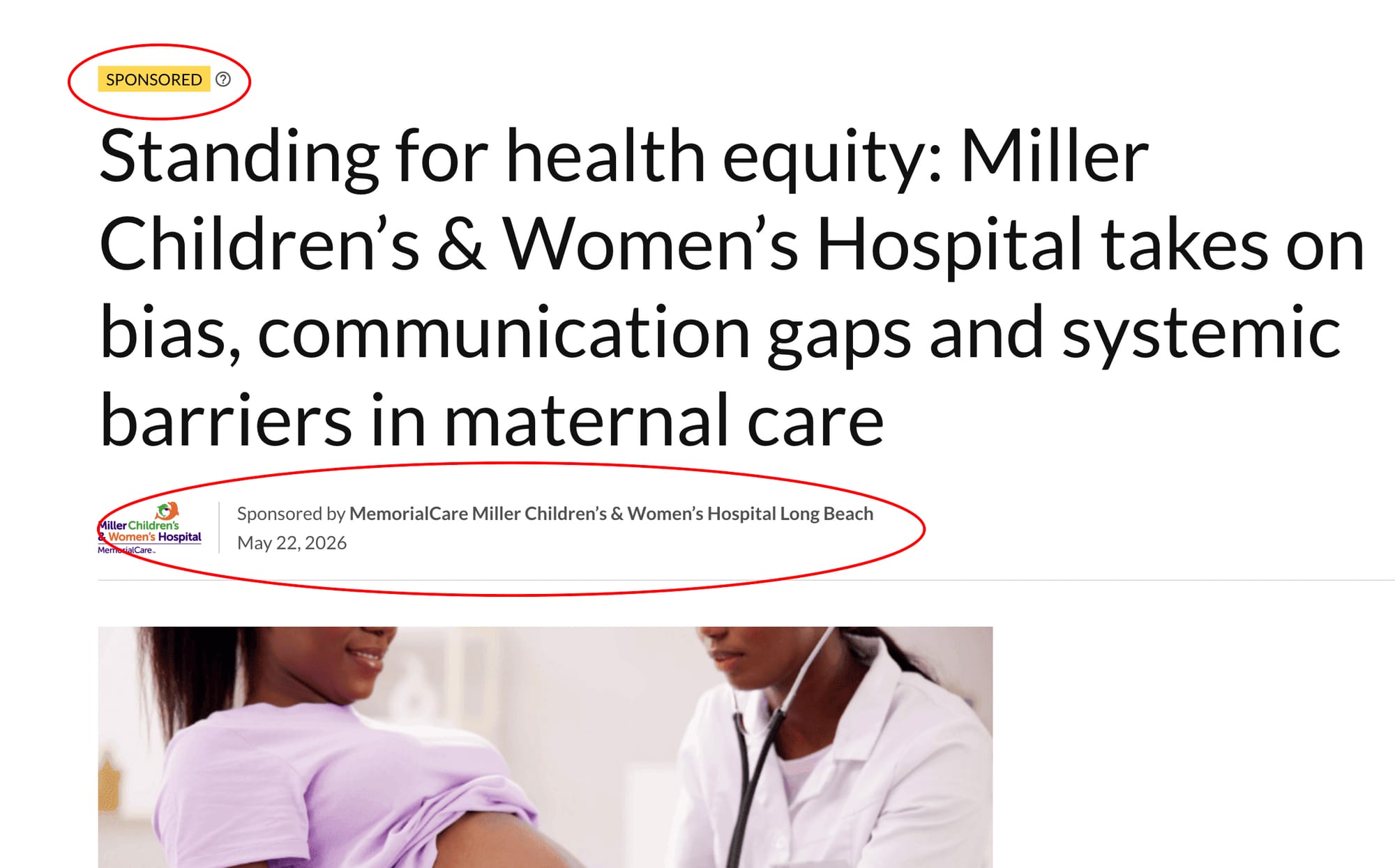
“Framing yourself as someone who’s showcasing something because of some kind of external arrangement versus someone who has found something worth sharing … is drastically different,” said one Long Beach bar manager who asked to remain anonymous.
“Not to disparage other small businesses, but I’ve seen overwhelmingly positive, one might call it glazing, reviews, of … restaurants that are doing nothing fun or new and half their food is like fucking Sysco shit,” the bar manager said. “He’ll write two or three articles sometimes about really sort of uninteresting, basic concepts. I have to assume there is some kind of an arrangement or some kind of benefit that he’s getting from those establishments.”
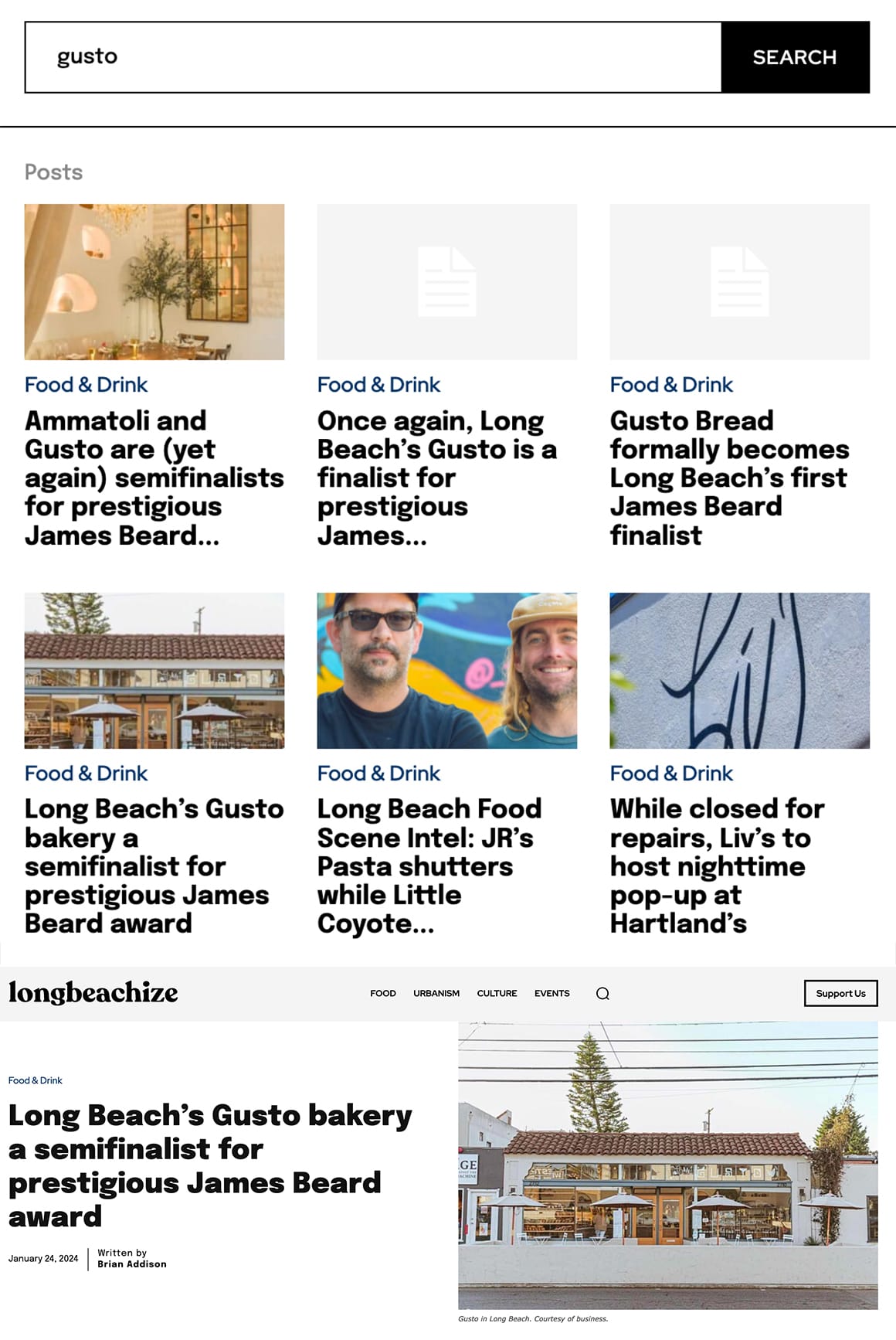
One of the most significant revelations from the Gusto incident was how Addison uses photos — more specifically, how he uses photos to which he does not have the rights. Enciso noticed that a photo in the Gusto story, which was credited to Addison, looked familiar. He quickly found the original on Yelp.
The image in Addison’s story was heavily edited to remove objects and people as well as adjust the lighting and color. Multiple matching reflections, however, indicate the image is the same despite its alterations.
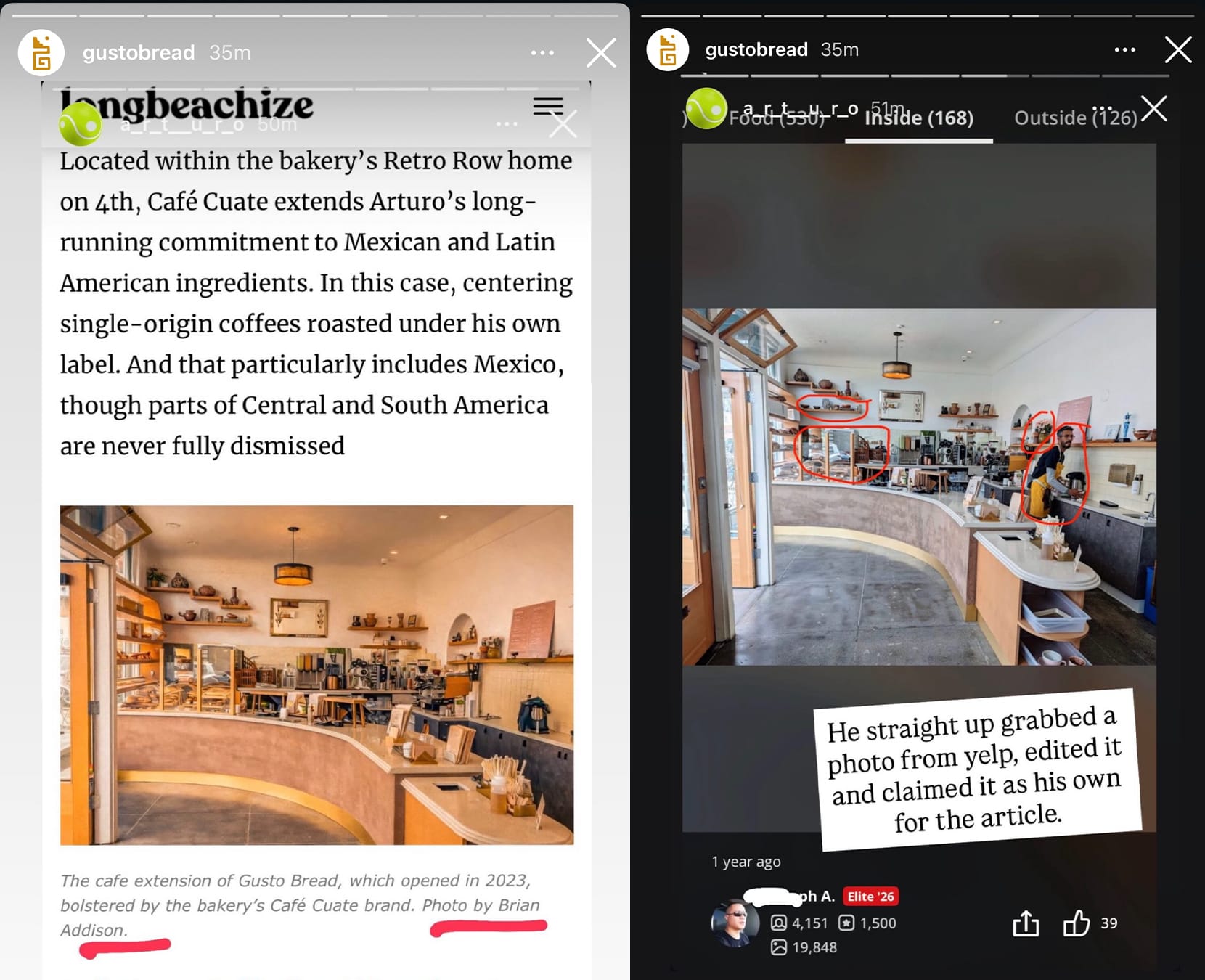
When publicly called out, Addison admitted to altering the image, claiming it was a “mistake” and that he had intended to replace it with a similar picture he took himself but ran out of time on his self-imposed deadline. He did not explain why he spent time editing the image if it was meant only as a placeholder.
Enciso said images in Addison’s other Gusto-related stories were also used without permission.
“He’s never once asked us for photos or anything,” Enciso said. Despite that, Addison had numerous exterior shots captioned with “courtesy of business.”
After the blowout, Addison deleted images from other Gusto-related stories, but did miss one. The exposure calls into question every photo Addison has marked as a “courtesy.”
A review of his website by the Watchdog found Addison regularly publishes photos taken from Yelp as well as images that match those on company websites and social media accounts. In a recent article about Belmont Shore restaurant South of Nick’s, Addison published six photos from five Yelp reviews. In all cases, the photos are captioned as “courtesy” of the business or individual.
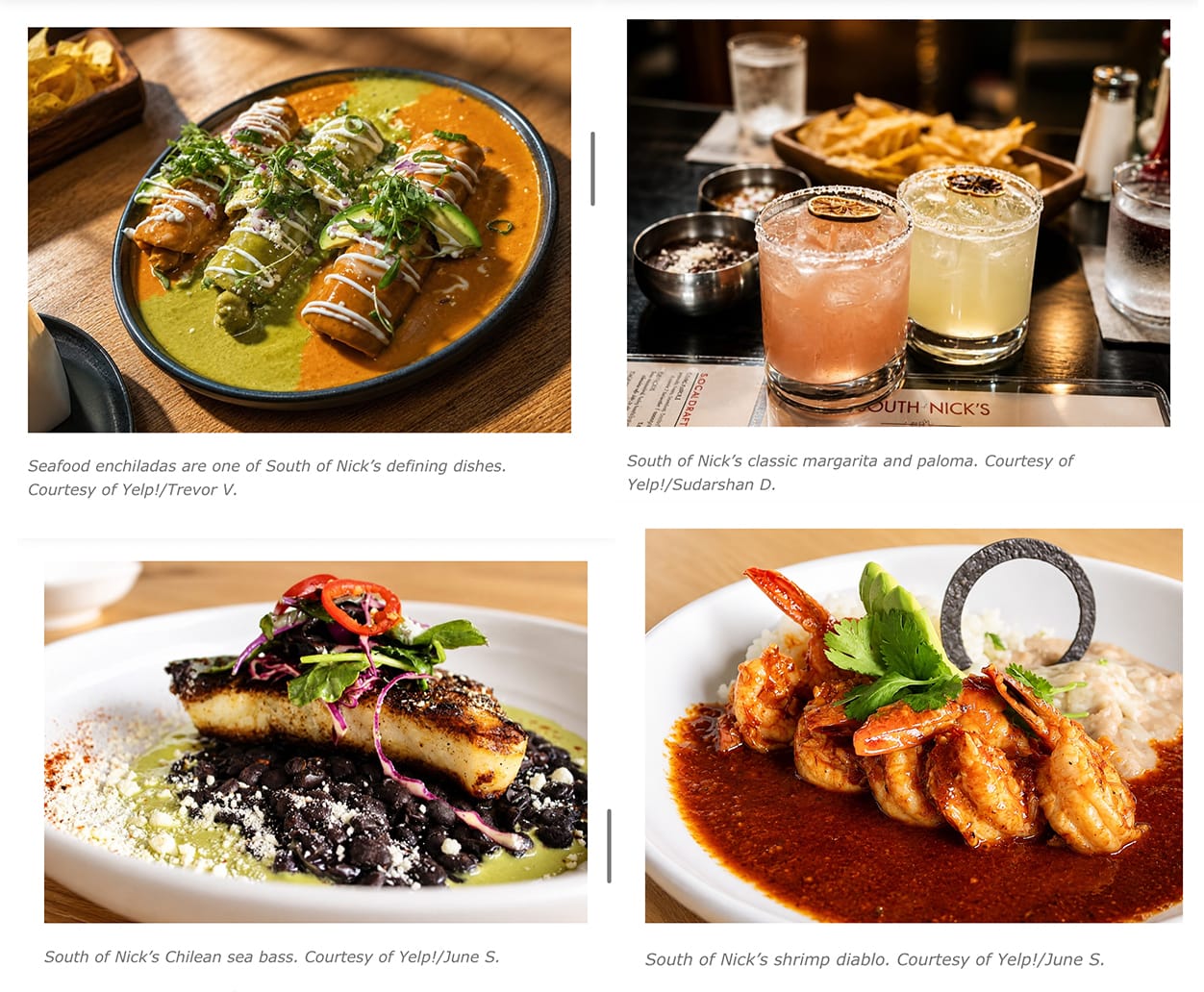
Yelp’s terms of service, however, clearly state the photographer, not the platform nor the business, retains ownership of the images.
‘The comments are open’
Addison’s loose ethics around photo use brought up sour memories for Diana Vu McDonough, owner of the popular fried chicken restaurant Lacquered, which she opened with her husband Scott eight years ago. In early 2022, Vu McDonough, who was an active member of Addison’s Facebook group, saw a post from another member about a Popeyes chicken sandwich.
The popular Cajun-inspired restaurant chain opened a location just up the street from Lacquered, which features a fried chicken sandwich as its specialty. Vu McDonough took the woman’s photo and made a meme comparing the Popeyes sandwich to her own.
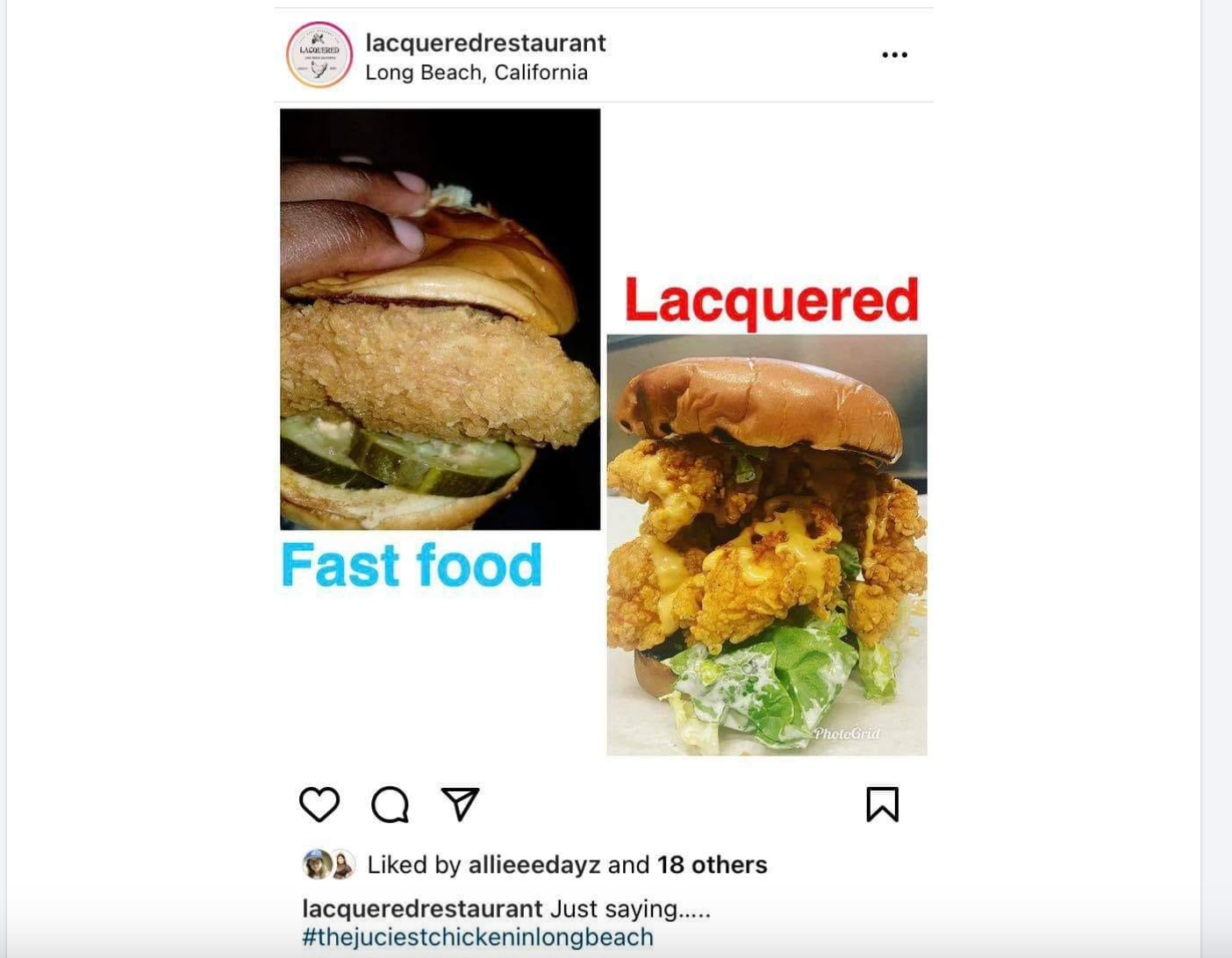
Addison quickly took to his Facebook group to denounce the local restaurateur for “stealing the image.” But his post was deleted after Vu McDonough accused Addison of owing her money for food from years prior.
In a recent interview with the Watchdog, Vu McDonough said the reaction to the post was swift.
“His whole mob came at me. It was weird and I felt very attacked,” she said, adding that Addison had also blocked her from the group. “So they’re talking shit about me and I can’t even fucking defend myself.”
Vu McDonough said Addison’s supporters, who dubbed themselves his “cronies,” sent her dozens of hate messages as a result of the posts. She said that is the power of Addison within the food community: If he has a problem with you, so do scores of others.
The Gusto incident, Vu McDonough said, highlighted Addison's hypocrisy: calling her out for using a photo in a social media meme while simultaneously publishing photos on his website that do not belong to him.
Amid the Gusto chaos, Addison also demonstrated that he can turn the temperature in his group down when he wants by turning off the comments if he doesn’t like what people are saying. He does not, however, always extend that courtesy to business owners when the comments turn negative toward them.
“In the end, we don’t want to hurt our businesse. You gotta put your business first, you gotta work with people you don’t like.”
— Diana Vu McDonough, owner of Lacquered restraurant
Fellippe Esteves, co-owner of Ubuntu, detailed two such experiences. The first came in August 2021 when a customer commented that they went to the restaurant for breakfast, saying the food was good, but that they were uncomfortable because workers were not wearing masks “even if it is pretty much outside. I don’t think I will go back anytime soon.”
Esteves said the post had hundreds of negative comments and he had to plead with Addison to remove it or, at the very least, turn off commenting. After some time, comments were turned off, but the damage was already done, Esteves said.
The next incident occurred in September 2024 after a customer complained that the bike rack outside Ubuntu’s Downtown location was removed. After some back-and-forth, with Esteves explaining the situation, he finally said customers don’t want to “watch smelly homeless right at the patio trying to steal bike parts.”
That snippet of the conversation made its way to the group and racked up more than 500 comments. Again, Esteves asked Addison to remove the post or turn off comments. This time, the answer was a flat no.
“I asked him why he was allowing this. I had like 500 freaking comments and he said ‘feel free to defend yourself. The comments are open,’” Esteves said. “He didn’t do shit. He let them drag us through the mud.”
Esteves compared his situation to Addison’s — while he was left out to dry, Addison was simply able to turn off the comments at his leisure, even delete posts and allegedly remove people from the group, when they didn’t go his way.
“Why don’t you go and respond to everybody just like you told me to do?” Esteves said.
‘Outright unethical’
In December of last year, Addison lambasted the Long Beach Post for a story written by Jacob Sisneros about the sale of popular tiki bar The Bamboo Club.
According to Addison, the Post “forced” the story on the owner, who requested to hold off. Despite the fact that both the owner and buyer were interviewed for the story, Addison said the way the Post approaches small businesses is “egregious” and “outright unethical.”
“There was zero need for them to rush this story or force it out when business transactions are on the line,” Addison wrote in a post to his food group. “And this charade that they are 'community-centric' is, at this point, absolutely absurd.”
Commenters on Addison’s Gusto post were quick to use his own words against him, pointing out that they also applied to his current situation. They also noted that, unlike Addison, the Post had interviewed the owners.
This was not the first time Addison had publicly attacked the Post and its sister publication, the Long Beach Business Journal, after his termination.
In a December 21, 2021 post in his group, he asked followers of his page not to share a piece published the same day in the Long Beach Business Journal regarding the expansion of popular Downtown restaurant Ammatoli into a vacant unit next door. Like Addison’s Gusto article, the Business Journal article, written by freelance writer Matt Miller, was based on signs posted in the business’s window.
In the comments, in a reply to another poster, Addison wrote an open edict to other food writers: “Wait for people to tell what they’re doing. Don’t make presumptions. And a sign going up is not a story unless you know what’s going on. And if you didn’t speak to someone from the restaurant, you’re making up things. Don’t do that. Just don’t.”
“Chefs aren’t elected officials or corporate entities,” Addison continued. “No need to hold their feet to the journalism fire unless we’re talking something far more serious than a… Than a dining room expansion.”
Miller declined to comment for this story.
In a November 10, 2022 post, Addison again blasted a Business Journal article published the day before.
The story, which I wrote, outlined concerns of Downtown business owners such as crime, construction and unhoused residents. The issues themselves were not news, as they had been well documented for some time, but one of the owners at Beachwood Brewing laid out just how dire the situation was in an email to the Downtown Long Beach Alliance, which was then forwarded to more than a dozen city officials.
“That email was intended for city leaders; not public consumption,” Addison told his followers. “... it was a private email that eventually forwarded [sic] to public officials.”
The DLBA, a city-contracted business improvement district, is subject to public records requests under the California Public Records Act the same as city officials, meaning the email was always public record.
Addison went on to write that Beachwood is “not closing; not now or any time soon.” The location was shuttered within the year.
‘You gotta work with people you don’t like’
If nothing else, the Gusto kerfuffle demonstrated that Addison does have his fair share of dissenters throughout the city. Outside of his own comment sections, nothing highlighted this fact more than a Reddit post titled “If you need another reason to hate Brian A -> check this out,” which generated more than 400 comments — most of which were not kind.
“Long Beach needs to move on from this guy,” one person wrote. “We deserve better.”
“I think he certainly likes to play TMZ of Long Beach food,” another said. “For me this was the final shenanigan and I’ve unfollowed all of his various social media accounts this morning.”
Many noted that they have unfollowed, or been banned from his group. One person called him a “petty gatekeeper.”
“Journalistic ethics? Spit-take material,” said another commenter.
“He’s all about him. He wants the headlines. He wants to be first. He wants to cause controversy,” said Tim Terrell, owner of Aroma di Roma. “He’s a tabloid.”
Terrell said Addison is “just a stirrer of the pot,” which is something Addison has leaned into by putting it in the bio of one of his social media accounts. But Terrell took it a step further saying that everyone and everything is “fodder, an ingredient, for his pot stirring. I don’t think he’s offering positivity for a healthy food scene.”
Former Michael’s owner Dene said he never had a personal issue with Addison, but that he often heard from other restaurateurs about various issues. Dene said Addison is not as well liked within the local industry as it appears.
“I heard from other restaurateurs that they couldn’t fucking stand him,” Dene said.
Enciso said numerous business owners reached out to privately share their stories after he publicly called out Addison. Multiple people said they would like to go on record but that they still operate in the city and can’t risk being on the wrong side of Addison or his followers.
“In the end, we don’t want to hurt our businesses,” Vu McDonough said. “You gotta put your business first, you gotta work with people you don’t like.”
His Facebook group is the foundation on which Addison’s success has been built. But while he is the one who grew it to its current 97,300+ members, he did not create the page alone.
Early in his most recent stint at the Post, managers assigned staff to create different Facebook groups as vehicles to disseminate stories. Addison worked with coworkers to create the food-themed page and acted as moderator.
“Now we’re the brunt of the joke, us pathetic people who think Brian should be held accountable. We’re so silly.”
— an active Long Beach restaurateur
When he was fired in 2020, Addison removed the other moderators, locking the Post and its staff out. Despite the page being created and maintained as part of a work assignment, and therefore belonging to the news organization, Post management offered to purchase the page from Addison as part of his severance, which he refused. The Post opted not to press the issue and Addison retained ownership of the page, then barred any Post story from being published to the forum.
“That tells you how much his ego is worth to him,” his former coworker said, adding that the group is now “full of sycophants.”
Ego notwithstanding, Addison needs the Facebook group for another reason: it’s core to his whole operation, serving as not just his largest distribution channel for his work, but his personal tip line. Each post to the group must be approved by him before it’s made public, meaning he sees every question and morsel of information before anyone else.
Essentially, Addison operates the perfect tip aggregator, which has allowed him to construct an illusion of omniscience when it comes to food news. When a post goes up, he will often be the first to comment, expanding on the information or answering questions with a link to a recently posted story on the topic. There is no way of knowing how long the initial post sat pending while Addison compiled a story.
Beyond providing him with an endless source of content, Addison has weaponized his group to hinder — and mock — other food writers as well as keep restaurateurs in line.
In a March 7, 2022 post to the page, Addison openly mocked the writing in a Post story by Miller.
After being called out by commenters (and turning off comments), Addison made a second post apologizing to his group for stating his opinion “cheekily.” But in his apology, Addison repeatedly noted that his comments were simply taken the wrong way.
He also made a distinction: It is OK to critique and make fun of paid writers but not members of the general public posting in his group.
‘It's never too late’
Controlling the flow of information, censoring other writers and comment sections, building up or tearing down businesses — Dene and the other restaurateurs think the level of power Addison holds within the local food scene is problematic.
“Essentially, he’s dictating what gets shown and what doesn’t,” said one former Long Beach business owner, who asked to remain anonymous. “He’s controlling the narrative, which is not fair.”
The entrepreneur, who said they never had an interaction with Addison directly, but rather is an outside observer, explained that he would be worried about his relationship with Addison if he still operated a business in Long Beach because it behooves owners to stay in his good graces or off his radar all together.
Addison’s Facebook group “holds a lot of weight” in the community, the former business owner said. They noted that there is a lot of “ragging” on small businesses in the group, which is perpetuated by Addison himself.
The group is notorious for drama, so much so that Addison even created merch that read “Long Beach Food Scene: Come for the food, stay for the drama.”
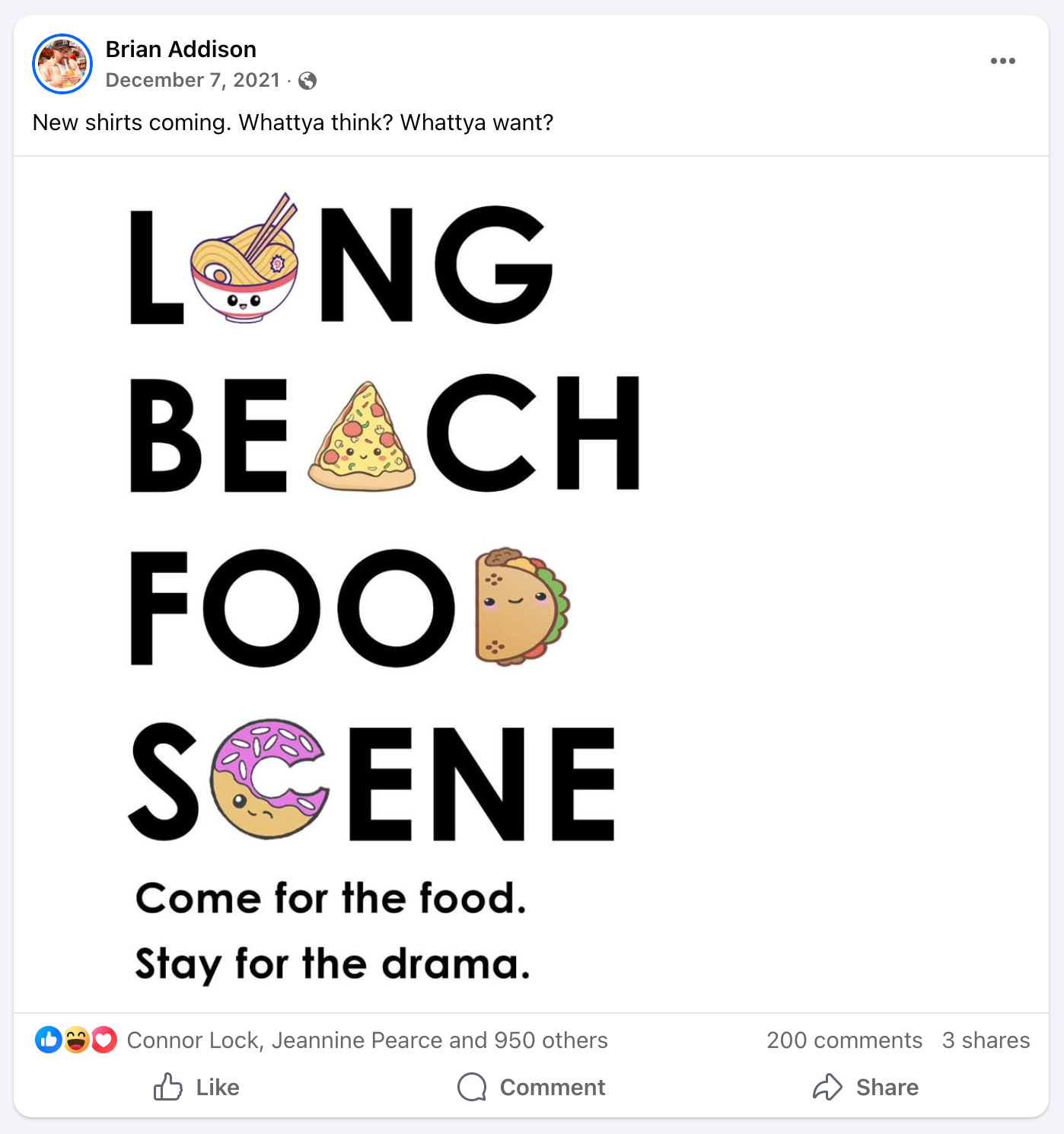
He has made a habit — and branding opportunity — out of trivializing criticism with humorous merch.
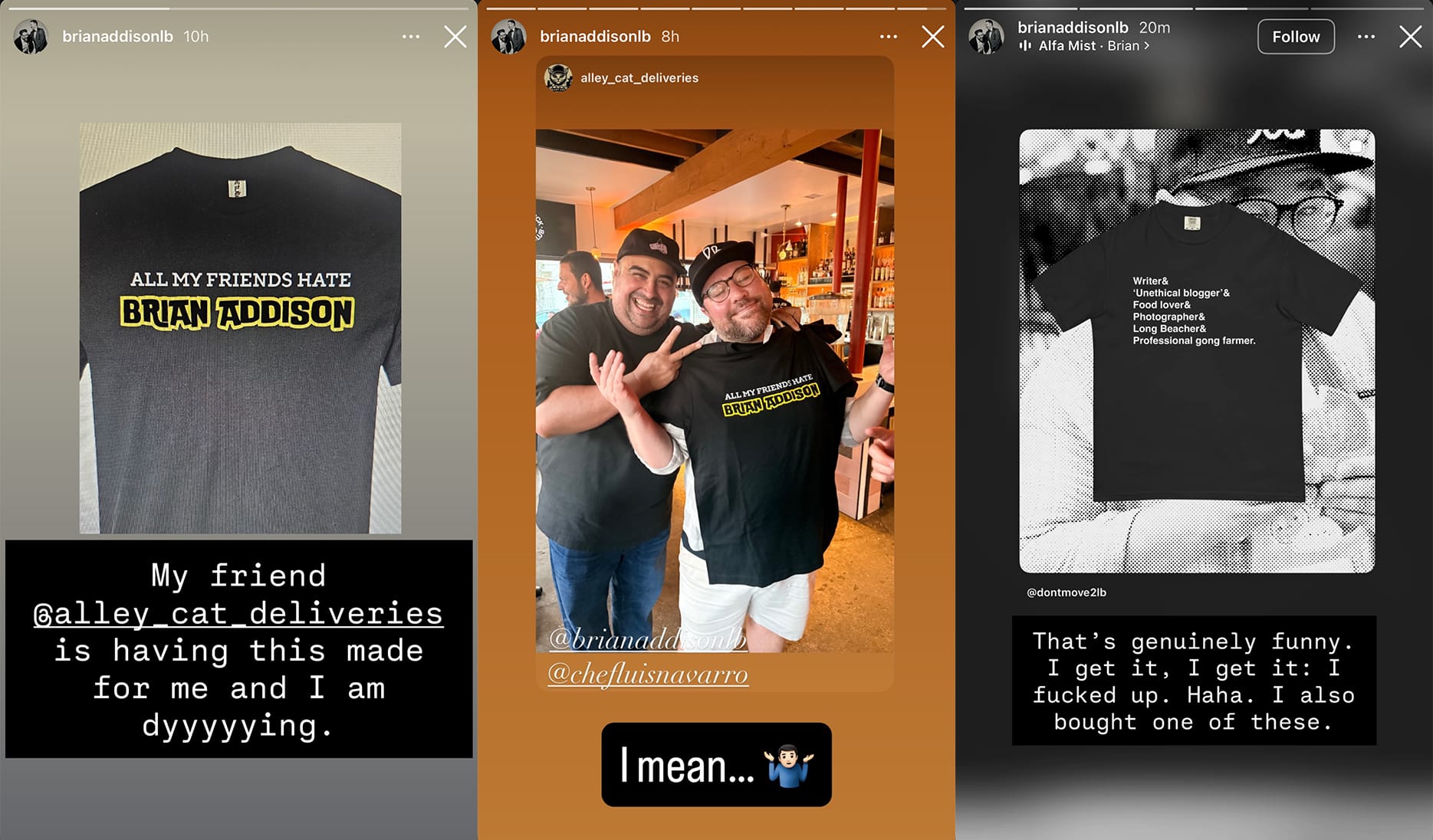
After Addison’s departure from the Post, in a private conversation with a restaurateur, I referred to Addison as an “unethical blogger.” This comment made its way back to him, and he added it to his social media bio.
After the Gusto blowback, two shirts quickly popped up online: One read “all my friends hate Brian Addison” and the other mocked Addison by putting his social media bio in large print, including the “unethical blogger” line.
While Addison did not design either shirt, he did promote both on his social media pages, once again turning criticisms of him into jokes, to the delight of his audience.
An active Long Beach restaurateur who asked to remain anonymous said the dynamic between Addison and his “cronies” reminds them of President Donald Trump and his MAGA followers.
“He’s nothing like the president [in terms of his beliefs], but in the sense that you have somebody that’s problematic but they are able to spin any subject as if they’re beyond reproach,” they said, pointing to Trump’s mugshot T-shirt. “And people will follow them, even through all those stumbles, without asking them to be accountable for their actions.”
It’s an “amazing skill” to be able to flip the script like that, the business owner continued. “Now we’re the brunt of the joke, us pathetic people who think Brian should be held accountable. We’re so silly.”
As it stands, Enciso said it was scary to speak out against Addison the way he did. He said the way to build community is by building trust, encouraging love and kindness, and being a good neighbor — attributes he does associate with Addison.
“I want to value Brian, I really do. I want to think of him as doing good for our community,” Enciso said. “And he probably has helped a lot of people by covering their shops. But then there’s the other side, where I saw similar stories to what we shared.”
“It’s never too late to turn things around,” the anonymous former Long Beach business owner said.
While Addison did not respond to interview requests, he has talked about receiving criticism before, including in an October 2016 article after being named — during a period between employment there — one of the Long Beach Post’s “40 under 40” winners.
“I enjoy being called out because I love learning the lesson and that just comes with the territory of speaking on things,” Addison told the Post. “It may not be fun licking your wounds but damn does it enlighten your perspective and show you how small you really are.”
We need your support.
Subcribe to the Watchdog today.
The Long Beach Watchdog is owned by journalists, and paid for by readers like you. If independent, local reporting like the story you just read is important to you, support our work by becoming a subscriber.