‘Win-Win’: Coastal Commission unanimously approves Bay Harbour settlement
The agreement will end 43 years of public access violations with the homeowners association funding numerous improvements.

State officials approved a sweeping settlement with one of Long Beach’s most exclusive bayside communities Thursday, ending more than four decades of public access obstruction.
The California Coastal Commission unanimously approved the new settlement agreement at its July 9 hearing in Ventura, finally securing full and unrestricted public access throughout the Bay Harbour neighborhood, a requirement under California’s Coastal Act the community first violated back in 1983, according to state officials and records.
While the Bay Harbour homeowners association removed the locked gates in late 2024 almost immediately after officials threatened millions of dollars in fines, the settlement finishes the job of ensuring public access to the greenbelts that run through the neighborhood and Jack Nichol Park, which also will get significant improvements.
Ann Cantrell, a member of the Sierra Club and Los Cerritos Wetlands Taskforce, testified during that Thursday hearing that though she prides herself on having visited all of Long Beach's public parks, she didn't previously know the public was allowed to visit Jack Nichol Park.
Commission Chairwoman Meagan Harmon called the settlement "really special" and a "win-win." It's "all too rare" in enforcement hearings, with both sides not only agreeing on terms but producing an agreement that includes so many positive impacts for the future, Harmon added.
Commissioner Raymond Jackson agreed, calling the settlement "heartening" and a "favorable outcome."
Surfrider Foundation official Jennifer Savage testified during the hearing that the settlement was a good one, especially since it made clear that the permit conditions the Coastal Commission places on projects to require public access "are not optional."
Though HOA representative Charlotte Hart had 30 minutes to make her case, she spoke for just one minute. She said the community was "happy with this resolution," adding that talks with commission staff to work it out were "super productive."
In a July 7 email to the Watchdog, Bay Harbour resident Leslie Wiberg said she thinks there are few, if any, original residents, and that the vast majority were unaware of any violations until the complaint was filed.
”Most residents purchased years after the developer filed bankruptcy (and died),” she said. “This includes HOA Board Members.”
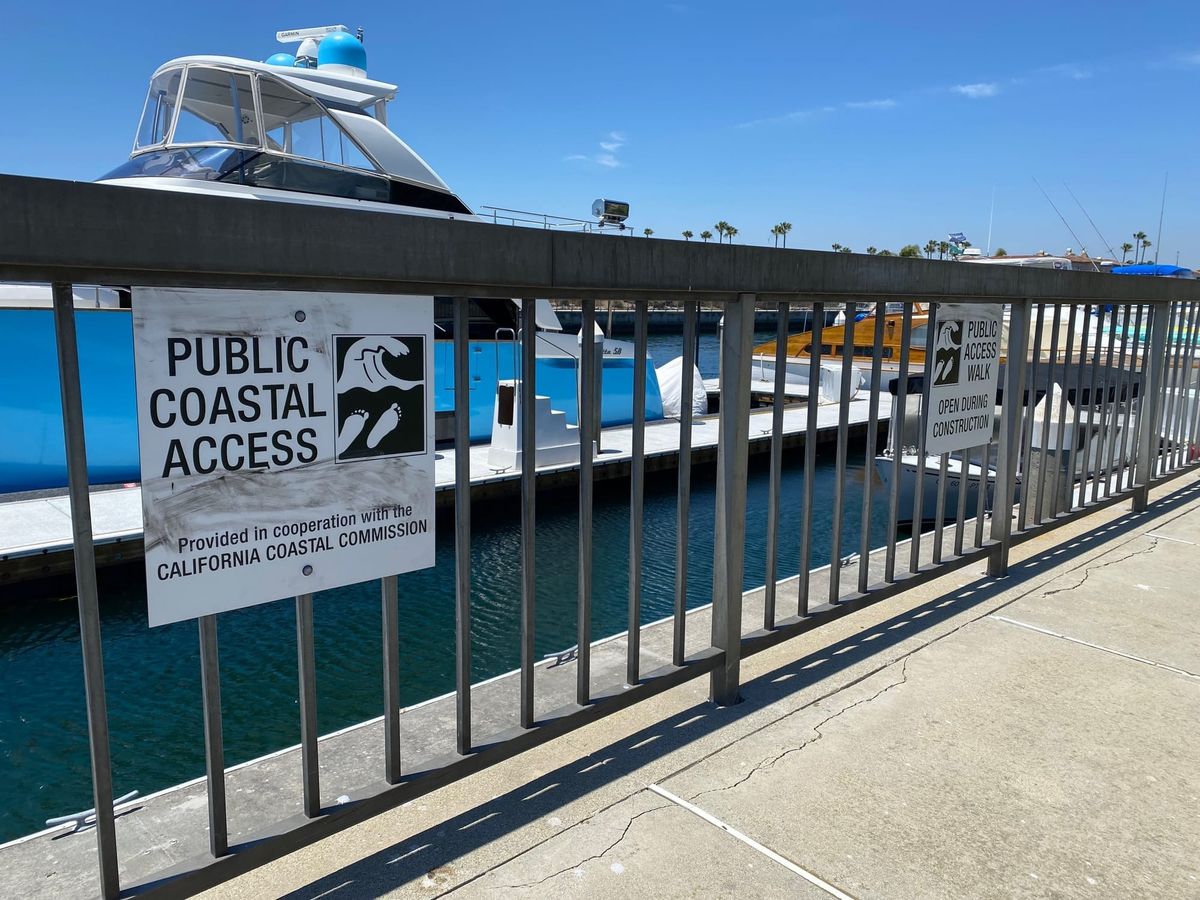
Under the settlement, which does not include any cash penalties, the HOA will have to install “over two dozen new public access signs that let people know about the greenbelt accessways and the Bayfront Walkway,” according to Commission reports.
One of those signs, located near the Bay Harbour entrance, will be nine square feet in size, Coastal Commission Headquarters Enforcement Counsel Rob Moddelmog testified during the hearing.
The HOA will also undertake whatever improvements are necessary to make the public access paths and sidewalks compliant with the Americans with Disabilities Act, according to the settlement. For instance, Costa del Sol Way, which runs along the outside of Bay Harbour from Loynes Drive to Jack Nichol Park, currently has at least one signpost stuck directly in the center of the sidewalk, making wheelchair access impossible, according to a Coastal Commission photograph included in the staff report.
The HOA will also undertake a considerable native plant program at Jack Nichol Park, which currently contains a lot of invasive and non-native foliage, but just a single Sycamore shade tree. As part of the settlement, the HOA will install an additional 21 native trees that will provide both habitat and shade for park users, and seven new interpretive signs that describe the area’s unique marine ecosystem.
The settlement agreement also requires the HOA to construct a variety of new amenities at Jack Nichol Park, including four more benches, a drinking fountain, another dog waste bag receptacle, a new bike rack and new public restrooms.
Surfrider's Savage testified that public restrooms “are not always the sexiest projects, but they're so important” because they make the park more enjoyable for visitors.
Commissioner Mike Wilson added that improvements to the park will also benefit Bay Harbour residents themselves, noting that the sounds of people enjoying the park will bring more "joy and happiness" to their community.
The current restrooms at the park, which are fenced off and only accessible to boat users at the marina, will remain as they are, according to commission staff. The tennis courts and swimming pools built within the greenbelt will also remain, according to the settlement.
Known as Costa del Sol until 1986, the community sits between the Los Cerritos Channel and Pacific Coast Highway, next to Jack Nichol Park. The Coastal Commission approved its development in early 1977, though it imposed six conditions on the project, the most important of which was the requirement that developers construct a large greenbelt in the neighborhood that was entirely open and accessible to the public.
Costa del Sol developers built the greenbelt, cutting the neighborhood into four quadrants, but ignored the public access requirement. Not only did they surround the greenbelt with locked gates, but they also constructed three tennis courts and two swimming pools within the greenbelt itself, further hampering public access.
None of the locked gates at the greenbelt entrances — or the smaller, unlocked gates that ran on the bayside walkway between the neighborhood and the marina slips on the Los Cerritos Channel — were permitted, according to Coastal Commission officials. The “No Trespassing” signs that had been affixed to the greenbelt gates were also unpermitted, state officials said.
Despite the Coastal Commission requirement that the greenbelt be accessible to the general public, the gates and no trespassing signs remained on site and untouched for nearly four decades.
In 2019, however, a member of the public complained to commission staff. After investigating the matter, staff sent a Notice of Violation to the Bay Harbour HOA on May 1, 2020. The notice alerted the HOA to the original Coastal Commission public access requirements and asked the association to dismantle the gates.
For the next four years, the HOA and the local commission staff went back and forth on what to do about the gates. Then on Sept. 18, 2024, after staff and the HOA failed to reach an agreement, the Coastal Commission sent the association a cease and desist order. This 10-page letter outlined the association’s violations and spelled out the tens of thousands of dollars in fines “for each violation and for each day in which each violation persists” that the association was now facing.
“We valued this at $2.5 million,” Moddelmog said. “We would have sought more than that.”
Within a week or two of the association receiving that order, the greenbelt gates came down, Moddelmog said.
We need your support.
Subcribe to the Watchdog today.
The Long Beach Watchdog is owned by journalists, and paid for by readers like you. If independent, local reporting like the story you just read is important to you, support our work by becoming a subscriber.