After 43 years of violations, gated community on cusp of providing full public access, Coastal Commission says
If approved, the settlement with the Bay Harbour HOA would require many new public amenities but eliminate millions in penalties.

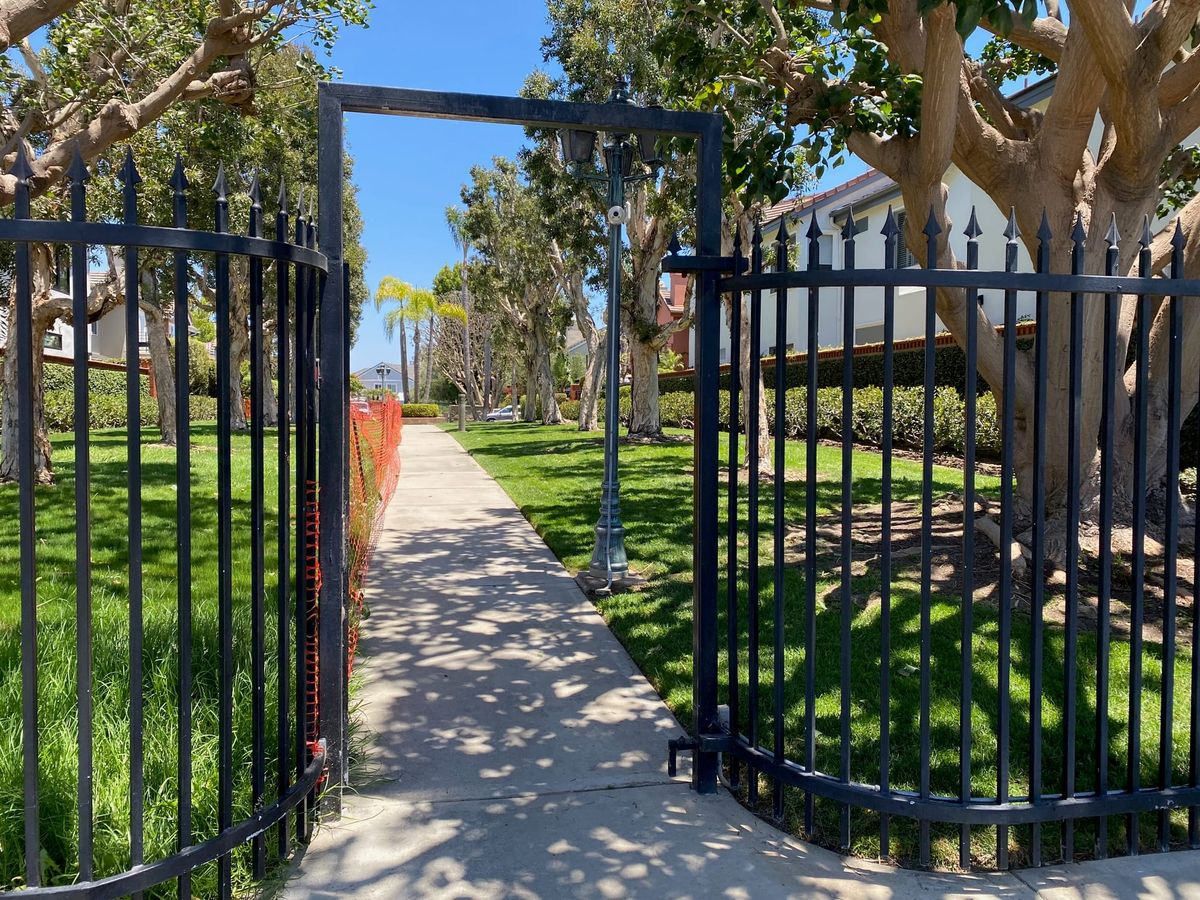
For more than four decades, public access to one of Long Beach’s most luxurious bayside communities has been obstructed, which is a violation of state law. That could finally end this month, state officials said.
The California Coastal Commission is set to discuss and potentially approve a settlement between the state and the Bay Harbour home owners association that would finally see full and unrestricted public access throughout the neighborhood, a requirement under California’s Coastal Act the community first violated back in 1983, according to state officials and records.
The HOA removed the locked gates in late 2024 almost immediately after officials threatened millions of dollars in fines, but the settlement would finish the job of ensuring public access to the greenbelts that run through the neighborhood.
“The public has a right to the coast,” commission Headquarters Enforcement Counsel Rob Moddelmog told the Watchdog in a phone interview. Moddelmog has spent much of the last five years working on getting public access restored at Bay Harbour.
In the phone interview, Lisa Haage, the commission’s overall chief of enforcement, agreed, adding that the agency “would rather settle than litigate.”
The agreement also would provide the public with a variety of new amenities, with enhancements to both Bay Harbour and nearby Jack Nichol Park, as well as improve access for disabled people and native vegetation, state officials said.
Charlotte Hart, a spokesperson for the Bay Harbour HOA, which encompasses about 200 homes, said residents there were feeling a mix of concern as to how much the settlement will cost each homeowner and relief that the settlement is at hand.
“The executive director’s team and the HOA arrived at a solution which serves the public well by elevating a public space and also extending the efforts being made throughout this region to conserve our environment,” Hart told the Watchdog in a June 30 email.
Known as Costa del Sol until 1986, the community sits between the Los Cerritos Channel and Pacific Coast Highway, next to Jack Nichol Park. The Coastal Commission approved its development in early 1977, though it imposed six conditions on the project, the most important of which was the requirement that developers construct a large greenbelt in the neighborhood that was entirely open and accessible to the public.
Costa del Sol developers built the greenbelt, which is shaped like a plus sign, cutting the neighborhood into four quadrants, but then ignored the public access requirement. Not only did they surround the greenbelt with locked gates, but they also constructed three tennis courts and two swimming pools within the greenbelt itself, further hampering public access.
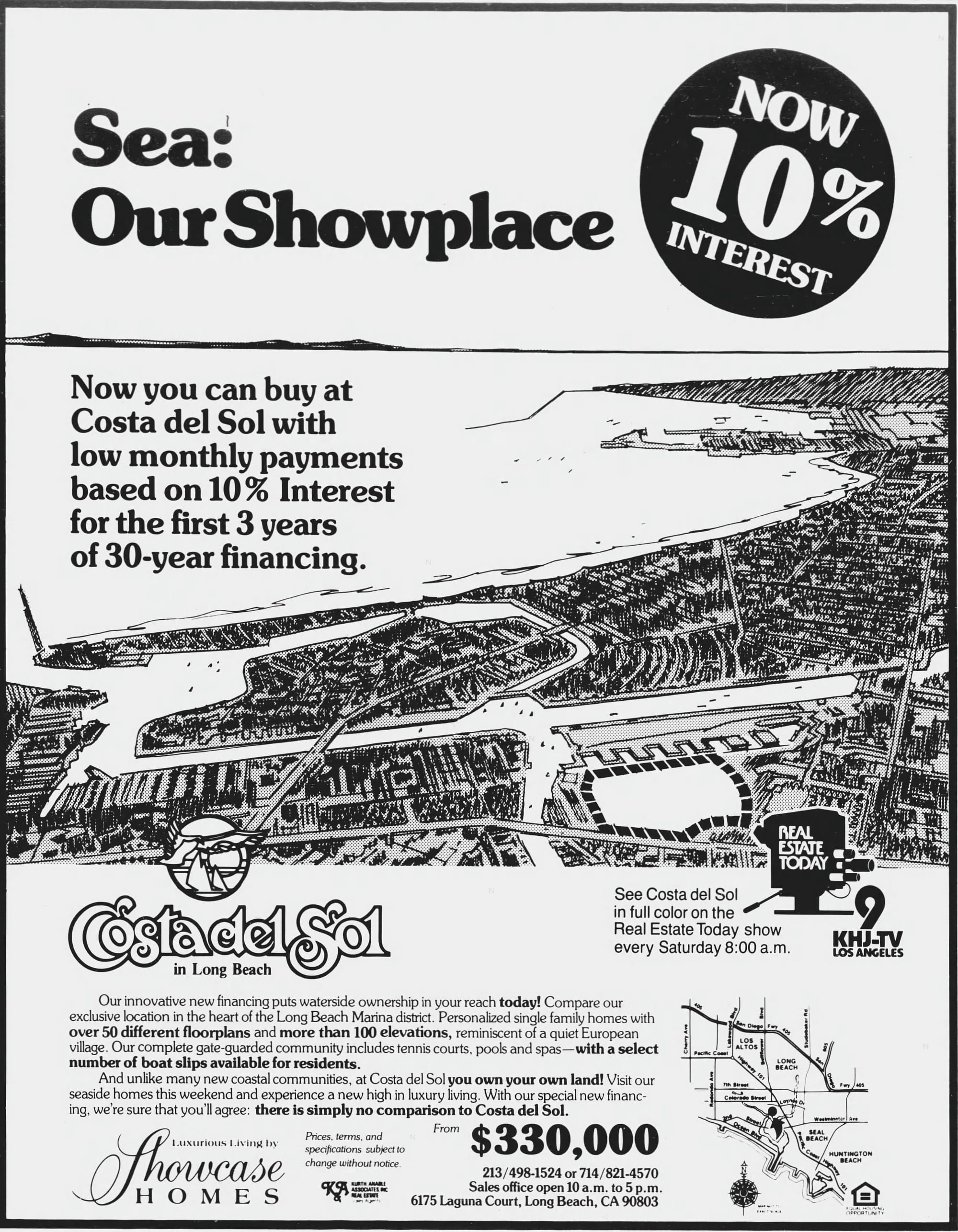
Though Coastal Commission staff reports state the locked gates dated to 1983, sales agents were promoting the development as “24-hour gate guarded” as early as May 1981, when the first homes in the neighborhood became available for sale, according to a May 9, 1981 Los Angeles Times story.
(Click here for additional background on the development of Costa del Sol).
An ad that ran in the Times the next year went even further, promoting Costa Del Sol as a "complete gate-guarded community" that featured "an exclusive location in the heart of the Long Beach Marina District."
None of the locked gates at the greenbelt entrances — or the smaller, unlocked gates that ran on the bayside walkway between the neighborhood and the marina slips on the Los Cerritos Channel — were permitted, according to Coastal Commission officials. The “No Trespassing” signs that had been affixed to the greenbelt gates were also unpermitted, state officials said.
Despite the Coastal Commission requirement that the greenbelt be accessible to the general public, the gates and no trespassing signs remained on site and untouched for nearly four decades.
In 2019, however, a member of the public complained to commission staff. After investigating the matter, staff sent a Notice of Violation to the Bay Harbour HOA on May 1, 2020. The notice alerted the HOA to the original Coastal Commission public access requirements and asked the association to dismantle the gates.
For the next four years, the HOA and the local commission staff went back and forth on what to do about the gates. Hart denied that the homeowner’s association was trying to buy time or stall the commission.
“This was part of the process, not a delay,” Hart said. “The local CCC staff was working with the HOA Easement Committee and then COVID happened.”
Hart said the HOA had requested a meeting with commission staff but did not receive a reply. “Now we know that their staff was reduced dramatically during this time,” Hart said.
Moddelmog confirmed that local commission staff had been greatly reduced during those years, which resulted in a “backlog” of cases. But he added that the goal of local staff is typically to resolve matters “informally” without the need for penalties or a hearing.
Also during this time, the HOA asked the City of Long Beach to build a dedicated bike lane along Costa del Sol Way, which it did. Though this alleviated some of the issues regarding bicyclist access through Bay Harbour to Jack Nichol Park, the city ended up bearing the construction and maintenance costs for the road, according to the Coastal Commission staff.
On Sept. 18, 2024, after staff and the HOA failed to reach an agreement, the Coastal Commission sent the association a cease and desist order. This 10-page letter outlined the association’s violations and spelled out the tens of thousands of dollars in fines “for each violation and for each day in which each violation persists” that the association was now facing.
“We valued this at $2.5 million,” Moddelmog said. “We would have sought more than that.”
Within a week or two of the association receiving that order, the greenbelt gates came down, Moddelmog said.
Haage noted, however, that the gates themselves were not Bay Harbour’s only violation. In fact, commission staff made clear that the homeowner’s association still has a lot of work to do to comply with the final settlement agreement. And much of that work involves signage.
“We’re obsessed with signs at the Coastal Commission,” Haage said, adding that the reasoning is simple: If people don’t know they have protected access to the greenbelts at a place like Bay Harbour, then it’s unlikely they will exercise their rights to that access.
Under the new settlement agreement, the HOA will have to install “over two dozen new public access signs that let people know about the Greenbelt Accessways and the Bayfront Walkway."
While two signs advertising public access did go up recently on the bayside walkway, Moddelmog said those signs dealt with construction at the marina slips unrelated to the greenbelt access issues. But even so, the wording on the signs were unambiguous: “Public Coastal Access – Provided in cooperation with the California Coastal Commission.”
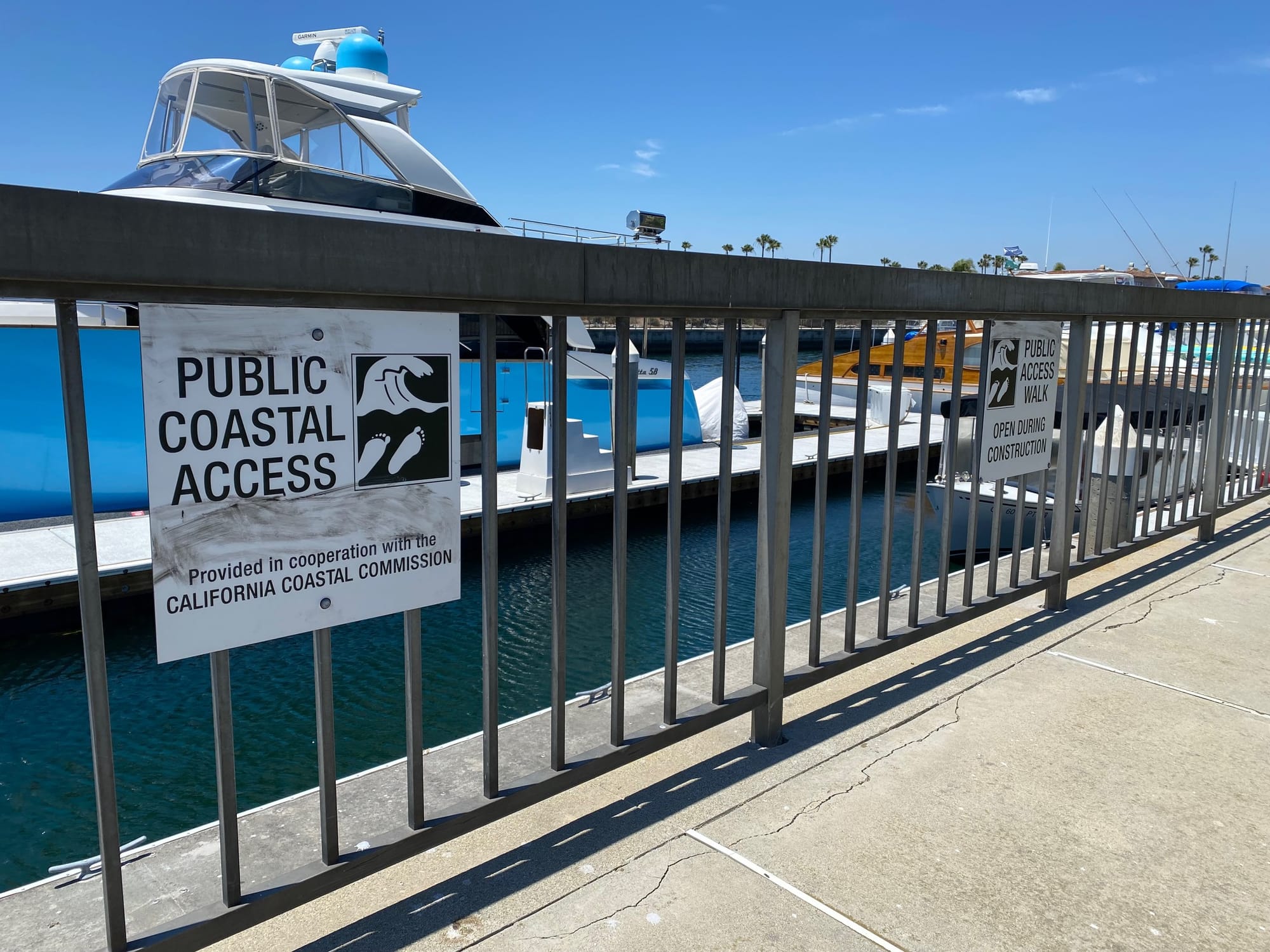
“We like to have our name on the sign,” Haage said. “It lets people know who to call if there’s a problem.”
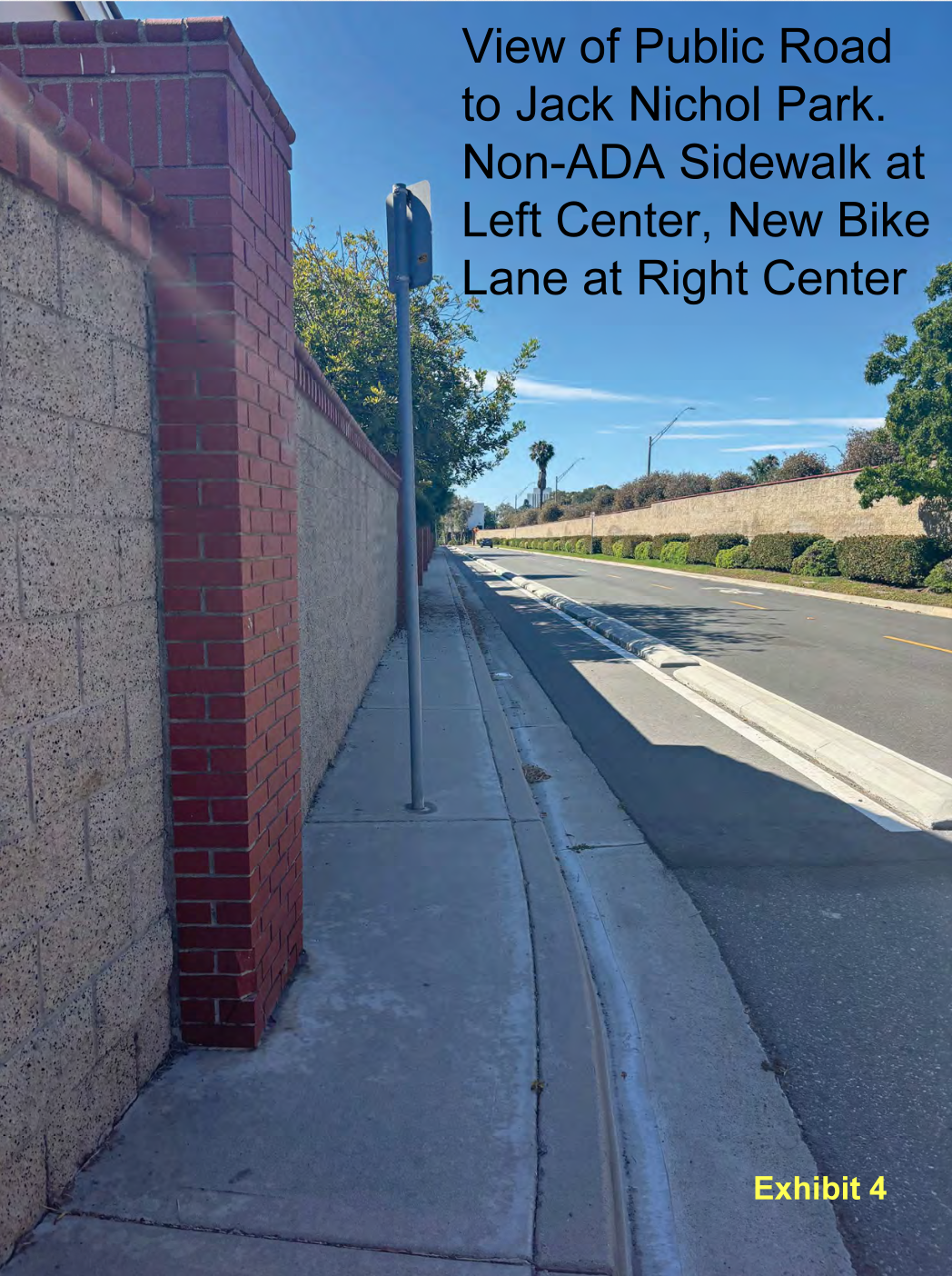
The HOA will undertake whatever improvements are necessary to make the public access paths and sidewalks compliant with the Americans with Disabilities Act, according to the settlement. For instance, Costa del Sol Way, which runs along the outside of Bay Harbour from Loynes Drive to Jack Nichol Park, currently has at least one signpost stuck directly in the center of the sidewalk, making wheelchair access impossible, according to a Coastal Commission photograph included in the staff report.
The HOA will also have to undertake a considerable native plant program at Jack Nichol Park, which currently contains a lot of invasive and non-native foliage, but no shade trees. As part of the settlement, the HOA will install a variety of improvements, including an additional 21 native trees that will provide both habitat and shade for park users, and seven new interpretive signs that describe the area’s unique marine ecosystem.
The settlement agreement also requires the HOA to construct a variety of new amenities at Jack Nichol Park, including four more benches, another dog waste bag receptacle, a new bike rack and new public restrooms.
“This will allow people who do not live nearby to enjoy the park and its bay views for as long as they want to, and make this area a much more comfortable place for the public to visit,” the commission’s Bay Harbour staff report states
The current restrooms at the park, which are fenced off and only accessible to boat users at the marina, will remain as they are, according to commission staff.
By agreeing to the terms of the settlement, the HOA will not face any cash penalties, Moddelmog said. In addition, the tennis courts and swimming pools constructed within the greenbelt will remain as they are, Haage said.
For their part, the HOA is working out how best to communicate to residents “how we anticipate paying the costs associated with the consent order,” Hart said.
The California Coastal Commission will discuss and possibly vote on the settlement agreement between the state and the Bay Harbour Homeowners’ Association at its July 9 meeting, which will be held at the Crowne Plaza Ventura Beach (450 E. Harbor Blvd., Ventura). The meeting is available for live streaming by clicking on the link above.
We need your support.
Subcribe to the Watchdog today.
The Long Beach Watchdog is owned by journalists, and paid for by readers like you. If independent, local reporting like the story you just read is important to you, support our work by becoming a subscriber.