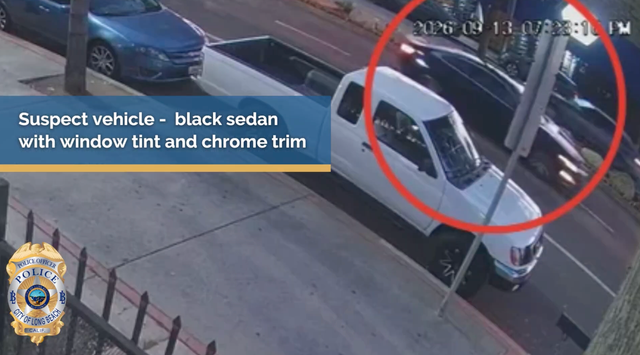
Long Beach is getting speed cameras. Residents, city staff and advocacy groups have concerns.
The cameras will be operational this month and begin issuing tickets in December, but there are questions about how the city will enforce the fines and whether the system will perpetuate racial and economic bias.

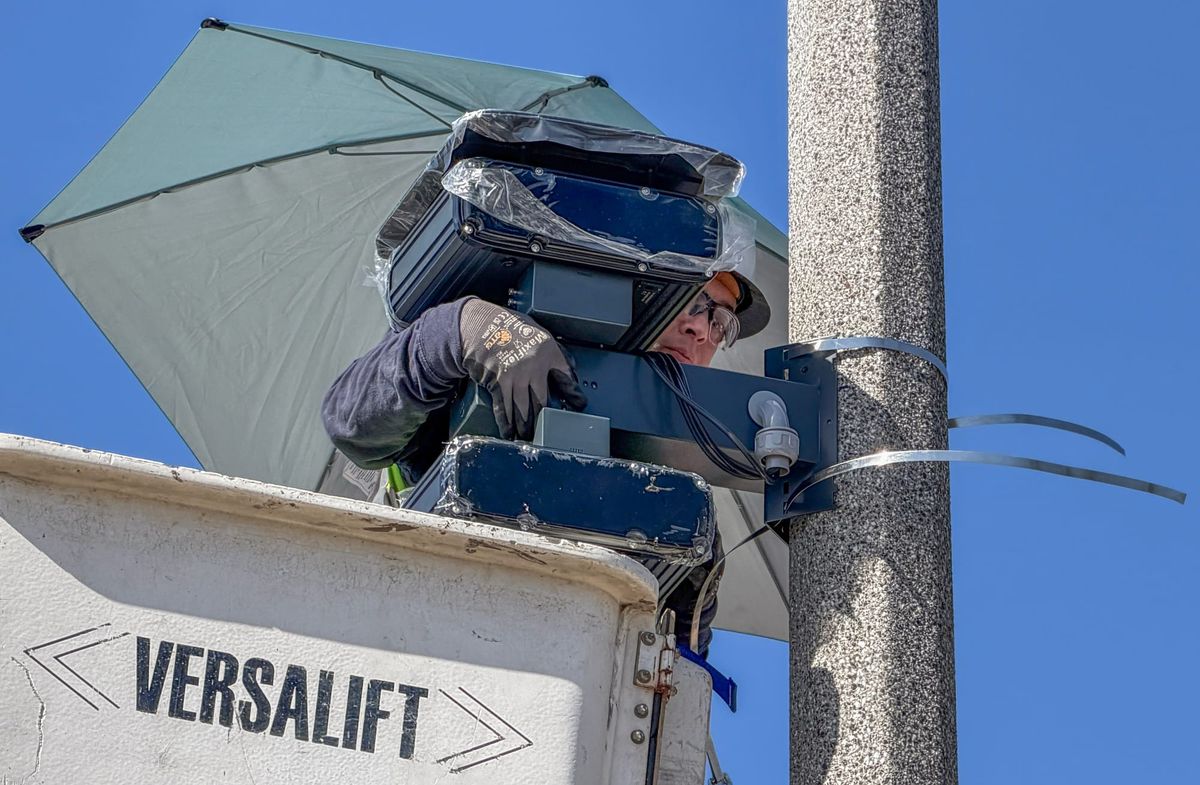
The city of Long Beach is in the midst of installing automated speed cameras at 18 locations across the city, which are set to come online this month but not start issuing tickets until December.
The city’s “Speed Safety System” is part of a five-year statewide pilot program introduced in Assembly Bill 645, which also includes the cities of Los Angeles, Glendale, Oakland, San Jose and San Francisco. The goal is simple: slow drivers down.
“There has been an increase in fatalities, an increase in driver behavior that's unsafe,” Joshua Hickman, director of the city’s Public Works Department, told the Watchdog. “The goal of this program is to … create a safer environment within our public right of way for all user groups, including vehicles, pedestrians, cyclists and the like.”
Long Beach’s 18 cameras will be located in all nine city council districts. The chosen locations are areas with a high volume of serious crashes and speeding incidents, including street takeovers, Hickman said. Others were chosen for their proximity to schools, he added.
Each camera will be accompanied by signage and speed feedback signs to warn drivers that they are approaching the cameras, according to Hickman.
“It’s really important to us that this is not a ‘gotcha’-type system,” Hickman said.
The system will be operational this month, but there will be a 60-day period during which speeding drivers will receive warnings, rather than tickets. In December, however, citations ranging from $50 to $500 depending on speed will be issued as laid out in the state bill, according to Hickman.
“There are opportunities for folks who can’t afford that to work on alternative programs such as community service or reduced fair, pending income requirements,” Hickman said. This was also a requirement in the bill.
The city estimates that the program will generate $5 million annually, half of which will be used to fund the program, while the other half will be reinvested into other traffic safety measures such as delineators, striping and “other efforts to help calm down traffic within our residential neighborhoods,” Hickman said.
If a certain camera is successful in reducing speeds consistently, or it stops generating revenue for some other reason, Hickman said the city can move it to another location.
“That would be great. That would be wonderful,” Hickman said. “It means we’d have a safer public right of way. It means we’d have less speeding. It means we’d have less fatal crashes and severe injuries, which is the intention of this program.”
The city’s goal is to see a 20% reduction in speeding, Hickman said. Other cities, such as San Francisco and Oakland, have reported dramatic decreases in speeding up to 80%, he added.
Public Works and Verra Mobility, the vendor that will be operating the camera system, can retain the confidential records and evidence, including the license plate picture, for up to 60 days after the case is settled, including appeals, according to the law.
The Long Beach City Council approved the contract with Verra Mobility during its Dec. 16, 2025 meeting. The company announced the finalized contract in a Jan. 20 press release. Several months later, on May 27, the stock price of the publicly traded company plummeted more than 70%.
In July, the Law Offices of Frank R. Cruz filed a securities fraud class action lawsuit on behalf of Verra Mobility investors. The suit alleges the company failed to disclose that its “optimistic plan” for growth relied on uncertain contracts.
Is the program enforceable?
Some people are skeptical of the potential effectiveness of the program, claiming that its enforceability is questionable.
Kat Mays, a clerk typist III who has worked for Public Works for eight years, spoke out during the Sept. 8 City Council meeting, saying “the vibes are shitty in a crumbling city,” playing off the city’s self-applied moniker “Vibe City.”
“You are investing in things that the residents do not want, like the automated speed enforcement program,” Mays said, adding that she has “serious questions about how much [the program] can be enforced.”
In a message to the Watchdog, Mays, who is also a union steward, said she had brought these concerns to Hickman in August.
“He didn’t have an answer, he kind of danced around the question,” Mays said.
The tickets are issued through Public Works, not the police department. Because it is issued to the owner of the car and not the driver, the ticket does not count as a point against anyone’s driving record, per the state law.
When pressed about what enforcement mechanisms the city has in place to ensure tickets are paid, no clear answer was given.
“This isn't a 'pay or else' system. This program was built to change driving behavior, not to maximize punishment,” spokesperson Jocelin Padilla told the Watchdog in a Sept. 15 email, adding that there is a multi-step process to contest the tickets as required by state law. “If someone goes through all of that, or simply doesn't respond at all, the citation remains an outstanding civil obligation.”
Hickman made it clear that the program is not affiliated with any law enforcement agency and that no data will be shared with any agency, including the Long Beach Police Department.
“[Data] will not be shared with anybody — any law enforcement or any groups outside Public Works and our vendor [Verra Mobility],” Hickman said.
While parking tickets are also a civil infraction issued by Public Works staff, the department is allowed to share that data. For example, it can notify the DMV of
unpaid parking tickets, which can result in a registration hold. When this happens, the person cannot renew their vehicle registration until the tickets are paid in full.
Such consequences will not be possible for the automated speeding tickets if, as Hickman says, no information will be shared with outside agencies. Similarly, the city would not be able to send the tickets to a collection agency.
Beyond Hickman’s own words, one section of the law states the speeding tickets “shall not result in the department suspending or revoking the privilege of a violator to drive a motor vehicle,” which Public Works could not do on its own anyway.
A surveillance state?
Social media comment sections for months have been filled with residents expressing concerns that the speed camera program is a step toward a dystopian surveillance state. This year, Flock Safety has repeatedly made headlines, most notably for dozens of instances of police officers stalking women using the surveillance system.
Hickman was adamant that the system being installed across Long Beach is not similar to Flock, which records video and offers live surveillance feeds. By contrast, Hickman said the city’s cameras are “static” devices that only take images of rear license plates when triggered by a vehicle traveling 11 mph or more above the limit.
“It’s not an automated license plate reader (ALPR) type system,” Hickman said.
When asked directly if the cameras have the capability of recording video or providing live feeds, Hickman said “the devices that are being installed behind me do not have that capability.”
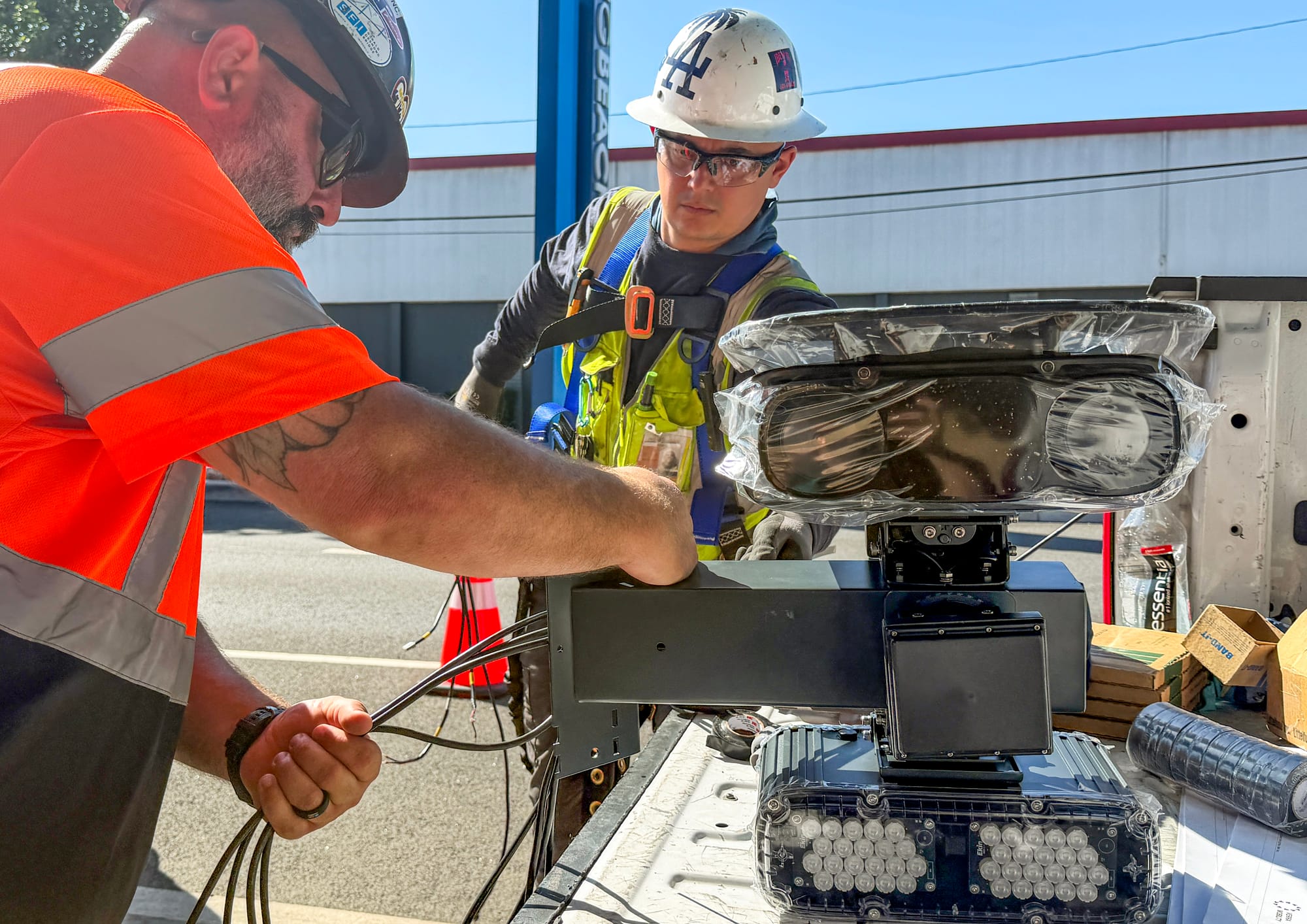
But the website for the cameras says otherwise. The cameras are the Ekin Box Spotter, which the company’s website states are ALPRs with 4K real-time video capability.
“Capture and analyze video footage to monitor traffic and identify potential hazards,” the site reads. “Automatically read the license plate of every vehicle in the field of view with alerts for wanted and stolen vehicles.”
The cameras have other “AI-powered monitoring” capabilities, including red light monitoring and U-turn detection, according to the site.
Of course, just because the functions are available does not mean the city will use them. But, as advocacy group Human Rights Watch wrote in an Aug. 7, 2023 letter to Senator Anthony Portantino expressing its opposition to AB 645: “History tells us that, despite assurances at the outset, expansions of policing technologies and systems of surveillance often shift from temporary to permanent and from limited to expansive.”
Under state law, facial recognition technology is prohibited as part of the speed camera pilot program.
“Traffic speed enforcement is critical to efforts in California to reduce factors that contribute to traffic collisions that result in fatalities or injuries,” the law reads. “However, traditional enforcement methods have had a well-documented disparate impact on communities of color, and implicit or explicit racial bias in police traffic stops puts drivers of color at risk.”
While the law seeks to eliminate racial bias by removing the human element, HRW argued that AB 645 would “continue and replicate racial bias.”
The bill outlines where cameras should be placed with a heavy focus on corridors with a history of traffic injuries and fatalities as well as geographic diversity.
“But in Oakland, for example, the network of streets throughout the city where historically over 60 percent of annual severe and fatal crashes have occurred covers areas that census data indicates would have higher concentrations of BIPOC and low-income community members,” HRW wrote.
Between 2015 and 2019, “race-neutral” traffic cameras in Chicago ticketed households in majority Black and Hispanic ZIP codes twice as much as majority white ones, according to a 2022 analysis by ProPublica. Similarly, William Farrell of the D.C. Policy Center found that people in Washington, D.C.’s Black neighborhoods were receiving more moving violations than people in white neighborhoods.
A Watchdog analysis of Long Beach’s camera placement and ZIP code census data shows the city is running the risk of having similar outcomes. Predominantly BIPOC areas of the city will have 11 speed cameras, while predominantly white areas will have two. Five cameras will be in areas with a more equal racial mix.
The 90803, 90808, 90814 and 90815 ZIP codes are a combined 19.4 square miles, making up 38.3% of the city’s land area. Between those four ZIP codes, which are predominantly white communities, there are only two speed cameras — that is one camera for every 9.7 square miles.
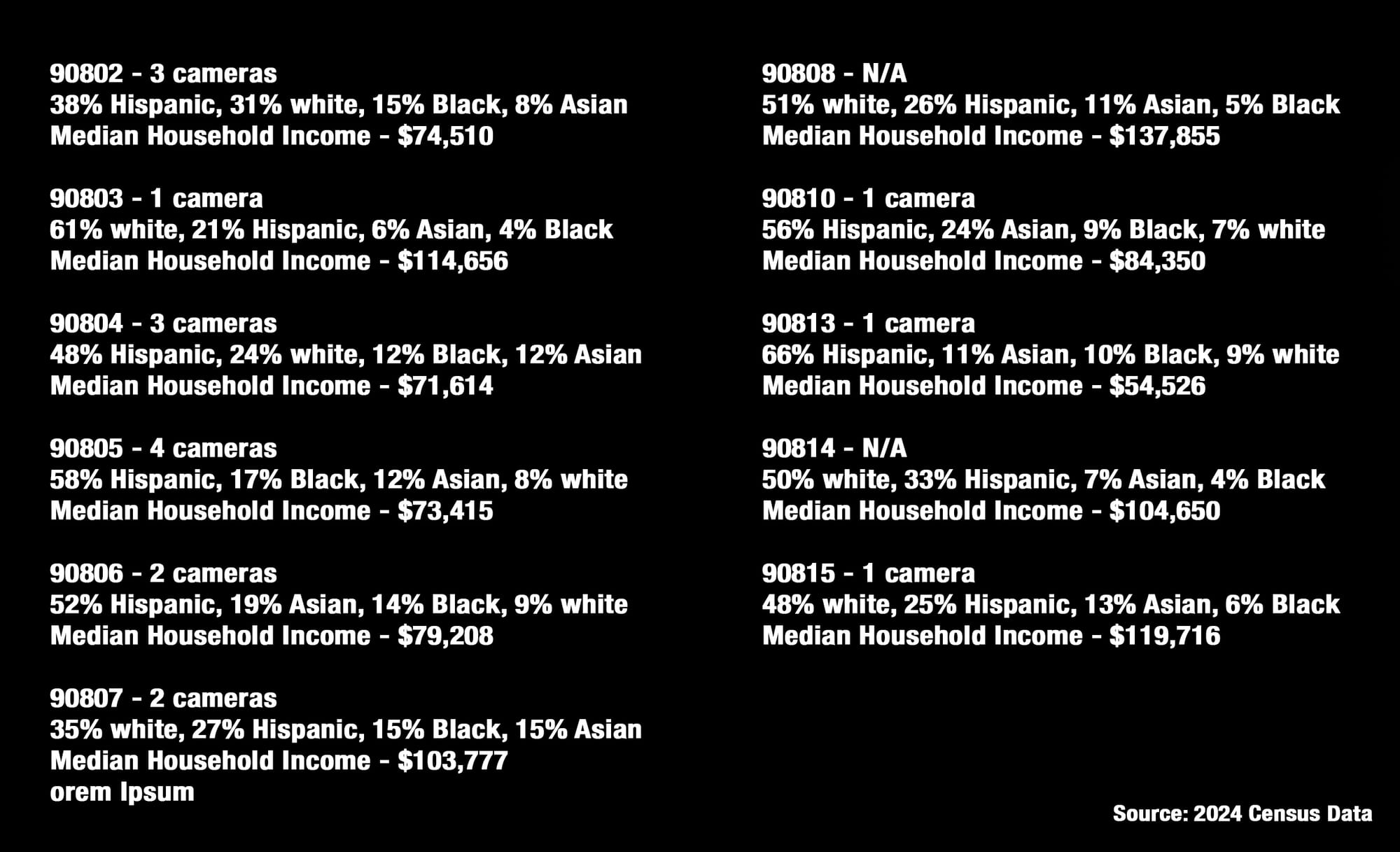
By contrast, 90804, 90805, 90806, 90810 and 90813 are a combined 24.1 square miles that make up 47.5% of the city’s land area. Those five ZIP codes, all with a high concentration of BIPOC residents, will boast 11 speed cameras, or one for every 2.2 square miles.
The ZIP codes with more cameras also have a significantly lower median household income, census data shows.
Early next year, the city will install two additional cameras along Pacific Coast Highway thanks to a new state bill signed by Gov. Gavin Newsom. The busy street was omitted from the city’s initial 18 camera locations because it is a state route.
Senate Bill 1279, which was introduced by Sen. Lena Gonzalez, did not specify the locations of the two additional cameras, which will be decided by the city.
The two PCH cameras will operate under the same guidelines as the other 18, bringing Long Beach’s total speed camera network to 20 — further stoking some of the public’s fear of an expanding surveillance state.
Of course, not everyone is against the cameras.
“Good,” said one redditor. “Maybe people will stop driving like dickheads.”
“Ten years ago I would have been outraged by this,” said another. “But now, after almost getting hit weekly while walking my dog… bring on the fucking cameras.”
We need your support.
Subcribe to the Watchdog today.
The Long Beach Watchdog is owned by journalists, and paid for by readers like you. If independent, local reporting like the story you just read is important to you, support our work by becoming a subscriber.